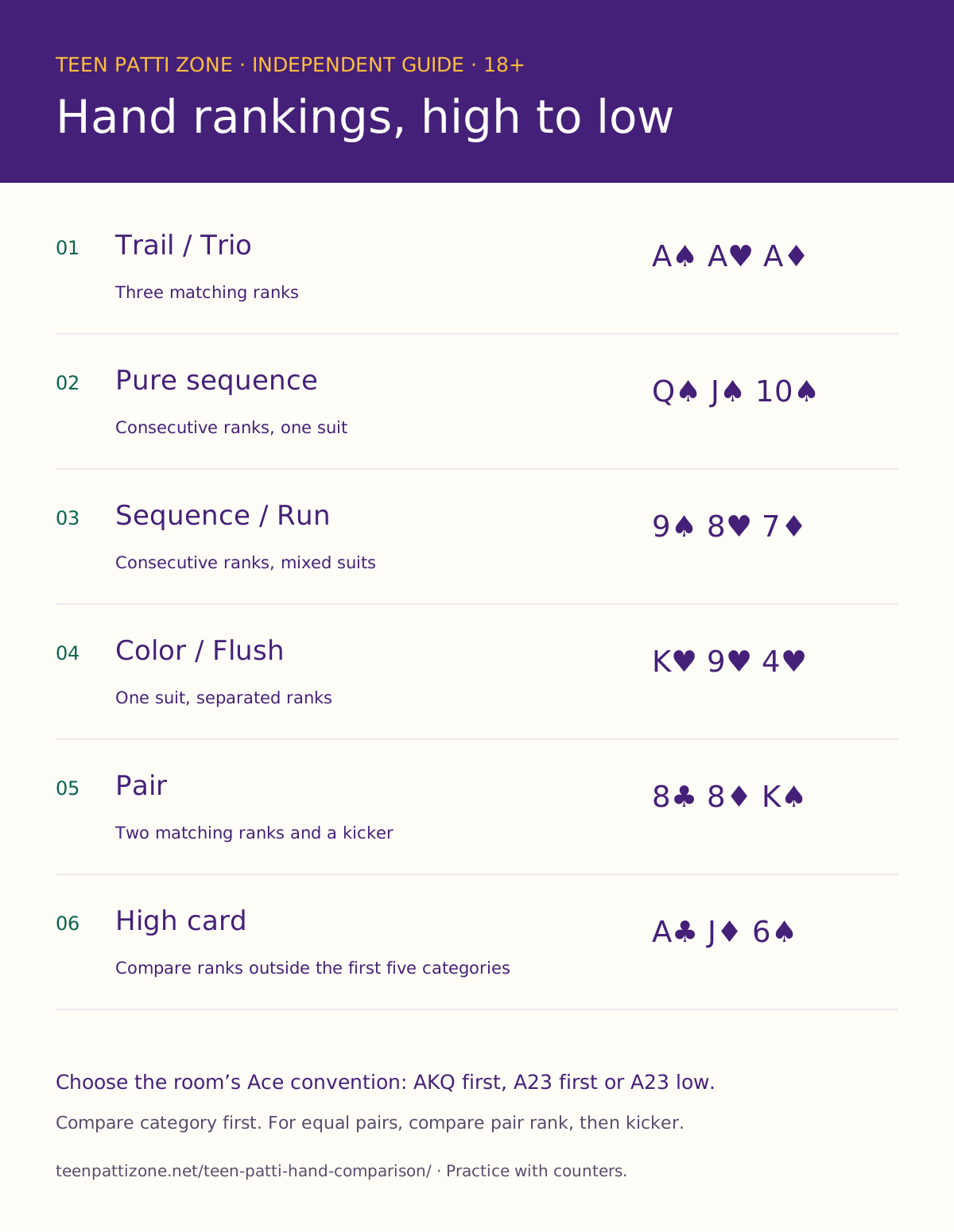
Trail, pure sequence, sequence, color, pair and high card is the standard category order. Compare ranks only after the categories match.
A Teen Patti ranking chart answers two different questions: which category is stronger, and how two hands within that category compare. Work through those questions in order. This reference uses three distinct natural cards per hand from a standard deck.
| Order | Category | Example | Comparison |
|---|---|---|---|
| 1 | Trail / Trio | 8♠ 8♥ 8♦ | Three matching ranks. Compare the rank of the trio. |
| 2 | Pure sequence | 9♥ 10♥ J♥ | Consecutive ranks in one suit. Apply the selected Ace rule. |
| 3 | Sequence / Run | 6♠ 7♥ 8♦ | Consecutive ranks across suits. |
| 4 | Color / Flush | K♣ 9♣ 4♣ | One suit with ranks outside a sequence. Compare ranks from the highest down. |
| 5 | Pair | 5♠ 5♥ Q♦ | Two matching ranks. Compare the pair, then the unmatched kicker. |
| 6 | High card | A♠ J♥ 6♦ | Compare the highest rank, then the second, then the third. |
Check 1: category outranks an attractive card
Take 2♠ 2♥ 7♦ against A♣ Q♦ 9♥. The pair ranks higher. The Ace belongs to a high-card hand and is considered after category. The same method explains why a low sequence outranks a high color.
Read category as a complete shape. A pure sequence combines a run and a single suit. A color shares a suit while its ranks sit outside the sequence shape. Three equal ranks belong to Trail rather than pair.
Check 2: compare the correct ranks
For two pairs, compare the paired rank first. Q♠ Q♥ 3♦ outranks J♣ J♦ A♥ because Queens are the higher pair. The Ace kicker becomes relevant only after the pairs match.
For two equal pairs, compare the unmatched card. Q♠ Q♥ 9♦ outranks Q♣ Q♦ 7♣ because nine is the higher kicker. For color and high card, sort ranks from highest to lowest and compare the first differing rank. A-K-4 beats A-Q-J in either of those same-category comparisons because King is compared before the third card.
Check 3: state the Ace convention
A-K-Q and A-2-3 are recognised sequences in the profiles used here. The selected room decides their relative position. Our comparison tool offers three explicit profiles, so the result can be read against the stated convention. K-A-2 sits outside an ordinary consecutive run.
Suits share equal standing in this learning model. Equal category and equal comparison ranks produce a tie. Follow the room’s procedure for resolving or distributing a tied round.
| Practice comparison | First check | Result under the stated model |
|---|---|---|
| 4♠ 5♠ 6♠ vs K♥ 9♥ 4♥ | Pure sequence vs color | Pure sequence ranks higher |
| 8♠ 8♥ 2♦ vs 7♣ 7♦ A♥ | Pair rank | Pair of eights ranks higher |
| A♠ J♥ 6♦ vs A♣ J♦ 5♣ | Third descending rank | Six is the higher third rank |
| A♠ K♠ Q♠ vs A♥ 2♥ 3♥ | Selected Ace profile | Apply the named room convention |
Use the chart as a check, then practise
Choose two examples, name their categories and explain the comparison in one sentence. Change just one card and check again. The interactive hand check shows the category and the reason; the worked practice page lets you reveal each answer at your own pace.
Use the ranking reference with the main guide
The Teen Patti Master overview connects the hand chart with practice comparisons and Android source checks. Use the selected room convention for the actual game.
Source references
Read each source within its stated product, rule or file scope.